
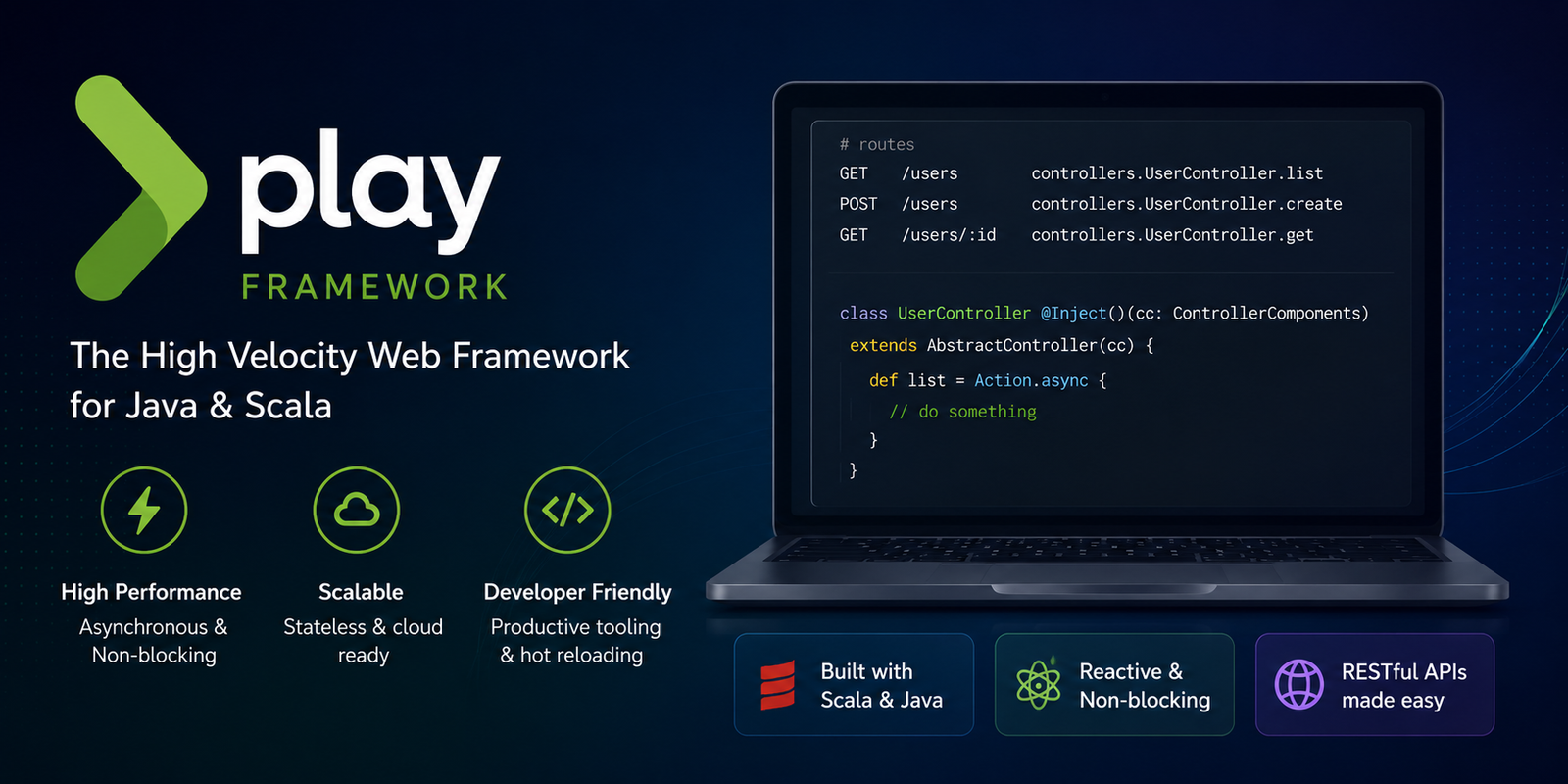
Modern web applications demand high performance, scalability, asynchronous processing, and developer productivity. Traditional web frameworks often struggle to meet these requirements without adding significant complexity.
This is where Play Framework stands out. Play Framework is one of the most popular reactive web frameworks for Scala and Java, designed specifically for building scalable, stateless, and cloud-ready web applications.
Its lightweight architecture, asynchronous processing model, and developer-friendly features make it an excellent choice for REST APIs, enterprise applications, microservices, and real-time systems.
What is Play Framework?
Play Framework is an open-source, high-performance web application framework developed for Scala and Java. Unlike many traditional frameworks that rely on heavyweight application servers, Play is stateless, non-blocking, and built on top of Akka and Pekko technologies for reactive programming.
Its design follows modern software development principles, making it ideal for cloud-native applications and distributed systems.
- REST API development.
- Enterprise web applications.
- Microservices.
- Real-time applications.
- High-concurrency systems.
- Cloud-native deployments.
Because Play is asynchronous by default, it can efficiently serve thousands of concurrent users with fewer resources.
Why Use Play Framework?
Many developers ask why they should choose Play Framework over traditional Java web frameworks. The answer lies in its architecture.
Play Framework is designed around modern backend development practices. Instead of blocking a thread for every request, Play processes requests asynchronously, improving throughput and reducing infrastructure costs.
It also follows a stateless architecture, making horizontal scaling much easier in cloud environments like AWS, Azure, and Kubernetes.
Key Features of Play Framework
Play Framework brings together reactive request handling, MVC structure, stateless design, dependency injection, hot reloading, centralized routing, JSON support, and cloud-ready deployment patterns.
- Reactive and non-blocking request processing for better CPU utilization, higher throughput, lower response times, and improved scalability.
- MVC architecture that separates business logic from presentation logic.
- Stateless design for horizontal scaling, load balancing, fault tolerance, and cloud deployments.
- Built-in dependency injection through Guice for controllers, services, repositories, and other components.
- Hot reloading during development so code changes are automatically recompiled.
- A powerful routes file for readable, type-safe, and centralized endpoint management.
- Built-in JSON support for converting Scala objects to JSON and JSON back to application data.
- Cloud-ready deployment support for AWS, Azure, Google Cloud, Docker, and Kubernetes.
GET     /users          controllers.UserController.getUsers
POST    /users          controllers.UserController.createUser
GET     /users/:id      controllers.UserController.getUser(id: Long)
Play Framework Architecture
At a high level, Play Framework follows a clear request flow. The client sends an HTTP request, the routes file maps that request to a controller, the controller calls the service layer, the service layer uses a repository or DAO, and the response returns as JSON or HTML.
Client
   |
   v
HTTP Request
   |
   v
Routes
   |
   v
Controller
   |
   v
Service Layer
   |
   v
Repository / DAO
   |
   v
Database
   ^
   |
JSON Response
Understanding MVC Architecture in Play Framework
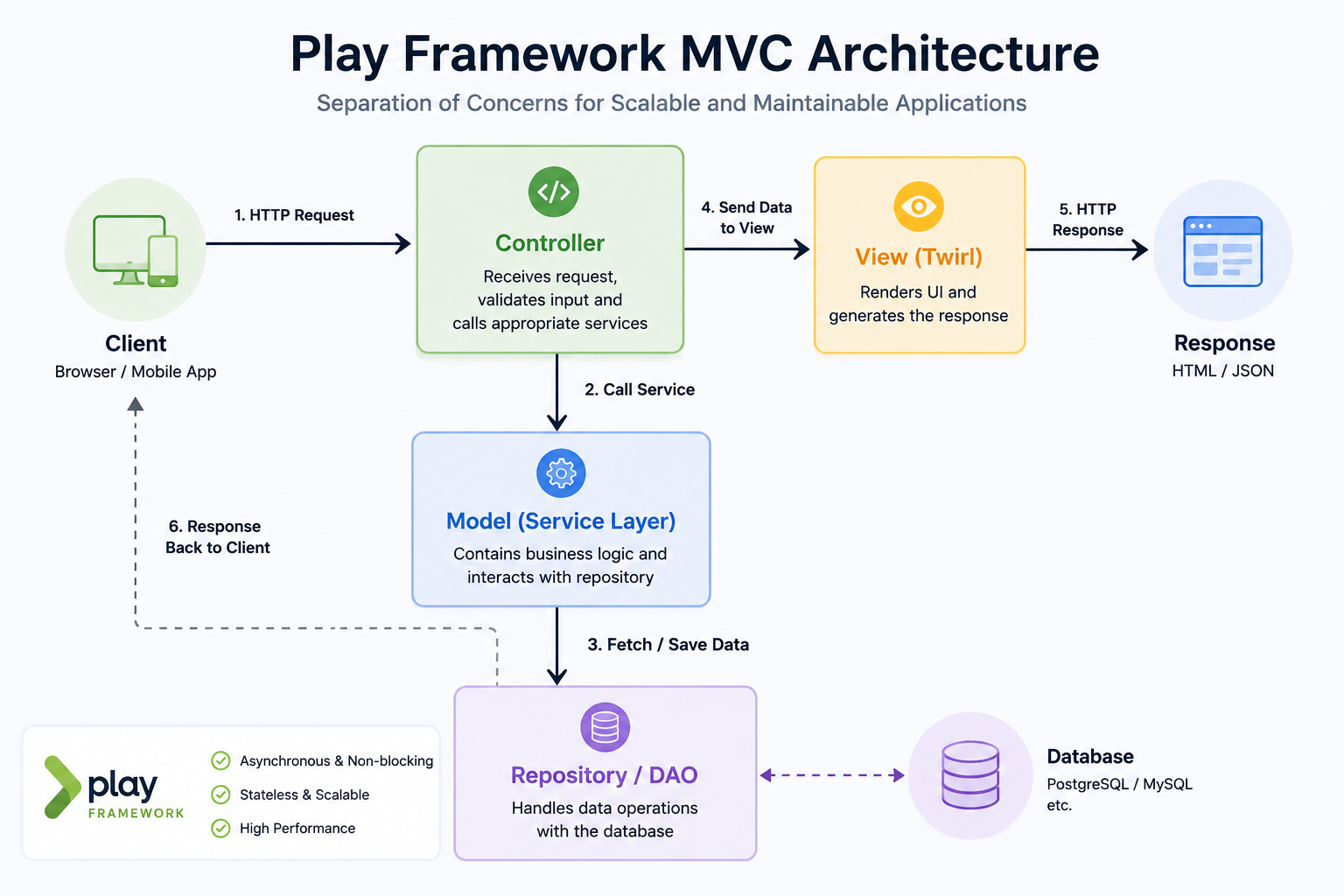
MVC stands for Model, View, and Controller. It is one of the core architectural patterns of Play Framework and keeps applications easier to maintain, test, and scale.
Model
The Model represents application data and business rules. It communicates with the database and contains entities such as users, orders, accounts, or domain-specific objects. Models should never contain UI logic.
case class User(
    id: Long,
    name: String,
    email: String
)
Controller
Controllers receive HTTP requests, validate input, call business services, and return HTTP responses. Whenever a client accesses an endpoint, the request first reaches the controller.
@Singleton
class UserController @Inject()(cc: ControllerComponents)
extends AbstractController(cc) {

    def hello = Action {
        Ok("Welcome to Play Framework")
    }

}
View
Views are responsible for displaying data. Play uses Twirl Templates for server-side rendering. Although many modern applications expose REST APIs instead of HTML pages, the View layer remains an important part of the MVC architecture.
@(username: String)

<html>
    <body>
        <h1>Hello @username</h1>
    </body>
</html>
Typical Project Structure
A standard Play project is organized around application code, configuration, routes, public assets, and build settings. Each folder has a specific responsibility, making the application easier to navigate and maintain.
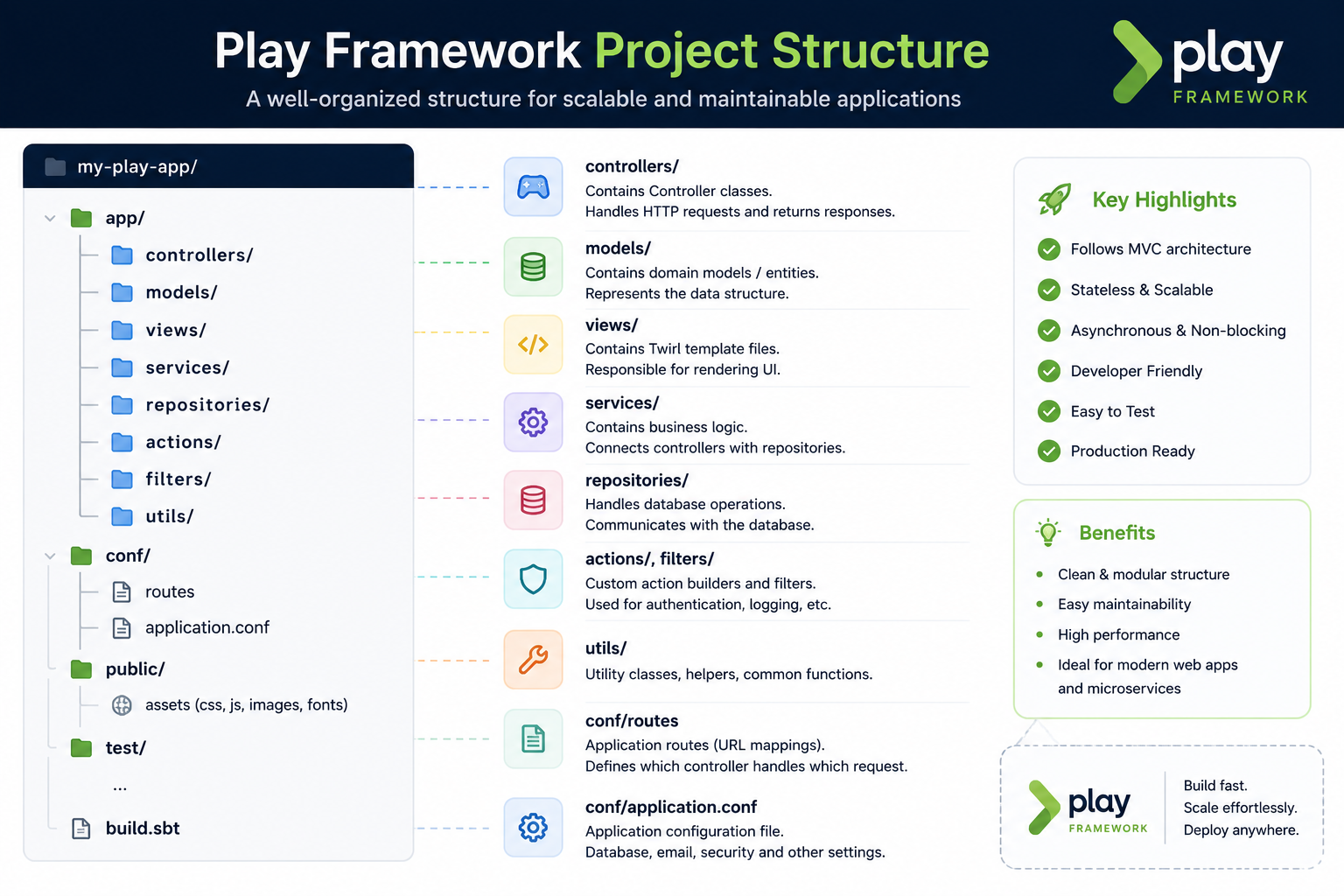
app/
|
|-- controllers/
|-- services/
|-- repositories/
|-- models/
|-- actions/
|-- utils/
|-- views/

conf/
|-- application.conf
|-- routes

public/

build.sbt
Request Lifecycle in Play Framework
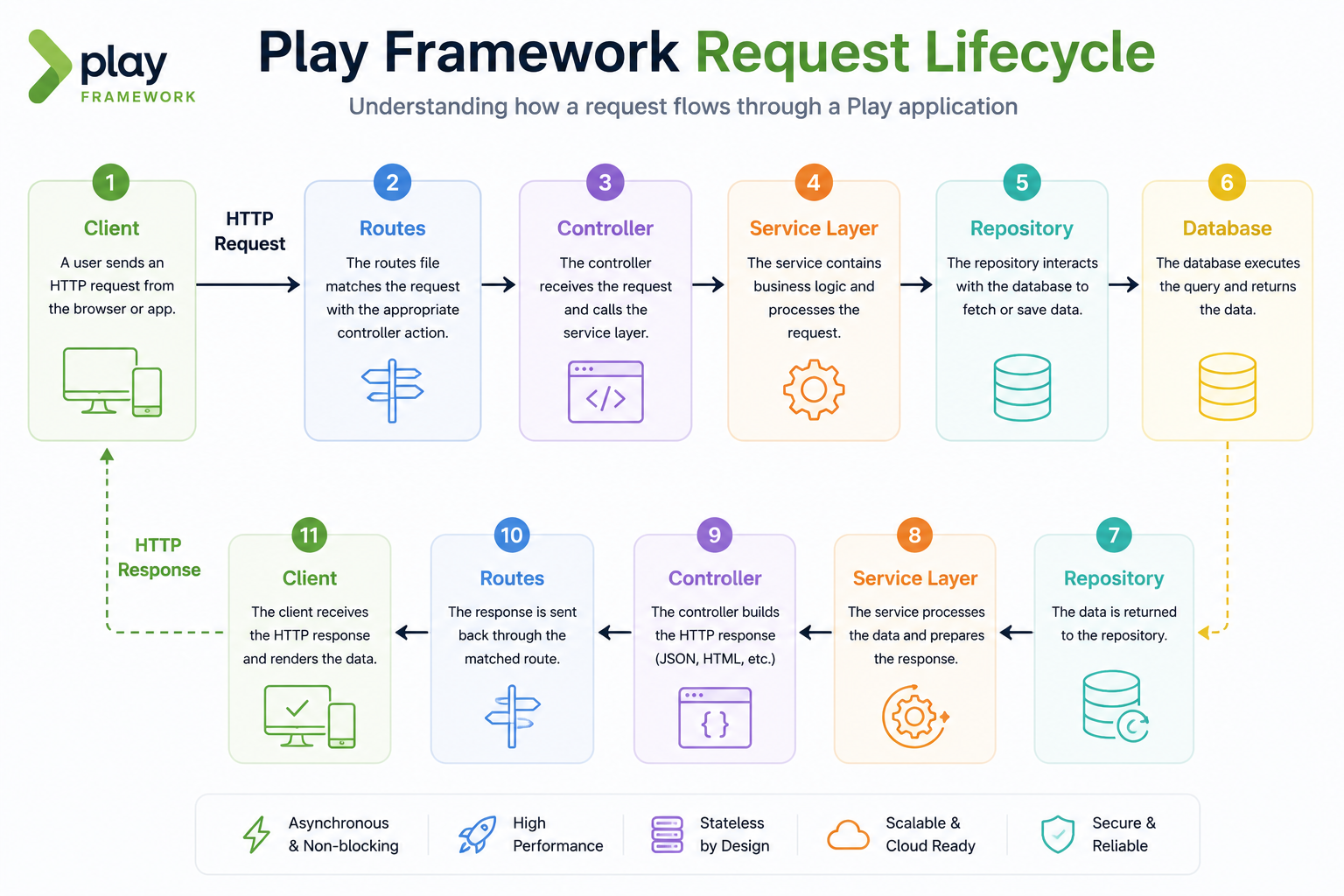
Understanding the request lifecycle is essential for backend developers. A client sends an HTTP request, the routes file matches the requested URL, the corresponding controller method executes, the controller invokes the service layer, the service calls the repository, the repository interacts with the database, and the response flows back to the client as JSON or HTML.
Creating a Simple REST API
A simple REST API starts with a route and a controller action. The route maps the URL to the controller method, and the controller returns the response.
GET /hello controllers.HomeController.hellopackage controllers
import javax.inject._
import play.api.mvc._
@Singleton
class HomeController @Inject()(cc: ControllerComponents)
extends AbstractController(cc) {
def hello = Action {
Ok("Hello from Play Framework!")
}
}sbt runNow open http://localhost:9000/hello and the endpoint returns: Hello from Play Framework!
Advantages of Play Framework
- High performance.
- Reactive programming support.
- Stateless architecture.
- Easy REST API development.
- Hot reloading.
- Lightweight design.
- Excellent Scala support.
- Cloud-native architecture.
- Type-safe routing.
- Built-in testing support.
When Should You Use Play Framework?
Play Framework is a strong choice when your application requires scalability, concurrency, and cloud deployment.
- Enterprise applications.
- Banking systems.
- Social media platforms.
- E-commerce backends.
- Chat applications.
- Streaming platforms.
- SaaS products.
- High-traffic REST APIs.
- Microservices architecture.
Play Framework vs Spring Boot
Both frameworks are excellent choices. Spring Boot is widely used for enterprise applications, while Play Framework particularly shines in applications requiring high throughput and asynchronous processing.
- Programming style: Play Framework is reactive, while Spring Boot is mostly blocking by default.
- Default concurrency: Play uses asynchronous processing, while Spring Boot commonly follows a thread-per-request model.
- Startup time: Play is generally faster, while Spring Boot is moderate.
- Learning curve: Play is moderate, while Spring Boot is usually easier for Java teams.
- Best fit: Play is strong for high-concurrency APIs, while Spring Boot is strong for enterprise applications.
- Cloud native: both frameworks are excellent options for cloud deployments.
Best Practices
- Keep controllers lightweight.
- Move business logic to the service layer.
- Use repositories only for database operations.
- Validate inputs before processing requests.
- Write asynchronous code wherever possible.
- Avoid blocking operations inside controllers.
- Organize code using feature-based modules for large applications.
- Secure APIs using authentication and authorization mechanisms.
- Write unit and integration tests regularly.
Conclusion
Play Framework is a modern, lightweight, and highly scalable web framework built for Java and Scala developers. Its reactive architecture, asynchronous request handling, stateless design, and clean MVC pattern make it an excellent choice for building high-performance REST APIs, enterprise applications, and cloud-native microservices.
Whether you are a beginner exploring backend development or an experienced engineer designing large-scale distributed systems, learning Play Framework is a valuable investment. By understanding its MVC architecture, routing system, asynchronous programming model, and project structure, you will be well-equipped to build secure, maintainable, and production-ready applications.
In upcoming articles, we will dive deeper into advanced Play Framework topics such as dependency injection, action builders, authentication and authorization, filters, database integration with PostgreSQL, JSON APIs, testing, deployment on AWS, and building complete production-grade backend applications.