
Apache Spark and Apache Parquet complement each other exceptionally well. While Parquet focuses on efficient data storage, Spark is responsible for executing distributed computations on that data.
When a Spark application reads a Parquet dataset, it does not simply open every file and scan each record sequentially. Instead, Spark uses a series of intelligent optimizations to minimize disk I/O, reduce memory usage, and execute queries in parallel.
A typical Spark read operation looks like this:
val employees = spark.read
  .parquet("/data/employees")
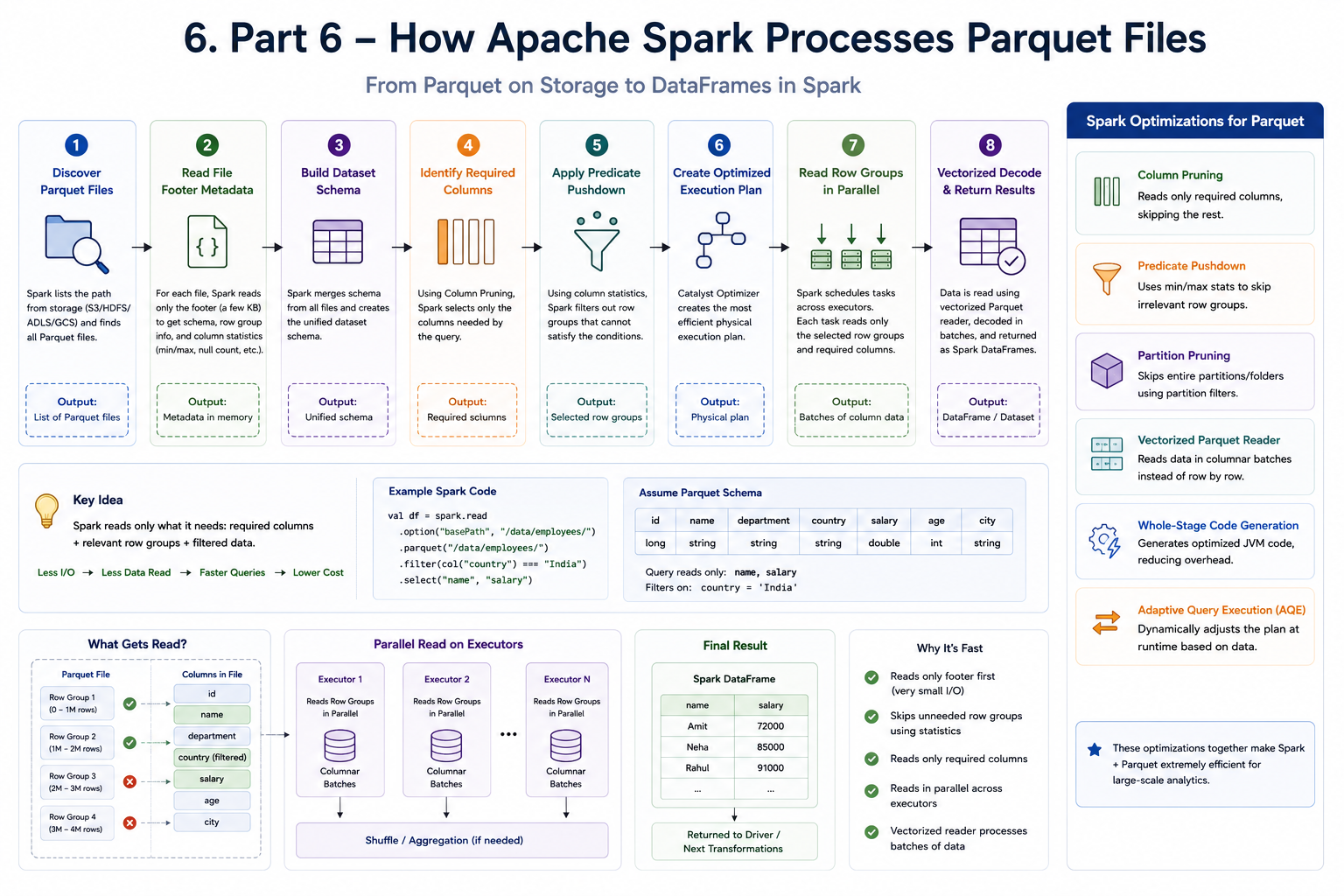
Although the code consists of a single line, Spark performs several internal steps before returning any data.
- Discovering Parquet files from the storage system.
- Reading the footer metadata for each file.
- Building the dataset schema.
- Identifying only the columns required by the query.
- Applying predicate pushdown wherever possible.
- Creating an optimized execution plan.
- Processing Row Groups in parallel across executors.
These optimizations allow Spark to analyze terabytes of data without reading every byte stored on disk.
Vectorized Parquet Readers
One of Spark's most effective performance optimizations is the Vectorized Parquet Reader. Traditional readers process data one record at a time.
Row 1

↓

Row 2

↓

Row 3

↓

Row 4
This approach involves repeated function calls and object creation, increasing CPU overhead. A vectorized reader works differently.
Instead of loading individual rows, Spark reads an entire batch of values from a column into memory.
Salary Column

────────────────────

72000

76000

81000

84000

91000

95000

102000

────────────────────
Processing batches provides several advantages:
- Fewer function calls
- Better CPU cache utilization
- Reduced object allocation
- Higher throughput
- Lower garbage collection pressure
Because analytical queries often scan millions of records, vectorized processing can significantly reduce execution time.
Catalyst Optimizer
Before executing a query, Spark converts it into a logical plan. Consider the following SQL statement.
SELECT department,
       AVG(salary)
FROM employees
WHERE country = 'India'
GROUP BY department;
Rather than executing this query directly, Spark first analyzes and optimizes it using the Catalyst Optimizer.
Catalyst performs several transformations, including:
- Constant folding
- Expression simplification
- Predicate pushdown
- Column pruning
- Join reordering when applicable
- Elimination of unnecessary operations
The optimizer then produces a more efficient physical execution plan. This process is automatic and requires no additional effort from developers.
Whole-Stage Code Generation
Spark introduces another optimization called Whole-Stage Code Generation. Instead of executing many small operators independently, Spark combines compatible operations into a single block of generated JVM bytecode.
Without Whole-Stage Code Generation:
Read Data

↓

Filter

↓

Project

↓

Aggregate

↓

Output
Each stage involves additional function calls and intermediate processing.
With Whole-Stage Code Generation:
Generated JVM Code

↓

Read

↓

Filter

↓

Aggregate

↓

Return Result
Reducing operator boundaries minimizes execution overhead and enables the JVM to optimize the generated code more effectively.
This is one of the reasons Spark SQL performs substantially faster than earlier MapReduce-based processing engines.
Adaptive Query Execution (AQE)
Since Apache Spark 3.x, Adaptive Query Execution has become one of the platform's most important runtime optimizations.
Instead of relying solely on the initial execution plan, Spark collects runtime statistics while the query is running. Based on those statistics, it can adjust the execution strategy dynamically.
Common AQE optimizations include:
- Switching join strategies at runtime.
- Coalescing small shuffle partitions.
- Handling skewed partitions more efficiently.
- Reducing unnecessary shuffle tasks.
For example, Spark may initially choose a Sort-Merge Join. After collecting runtime statistics, it may determine that one table is much smaller than expected and automatically switch to a Broadcast Hash Join, reducing execution time.
These decisions happen transparently without requiring changes to application code.
Filter Pushdown in Spark
Spark works closely with Parquet to push filtering operations as close to the storage layer as possible. Suppose the following query is executed.
SELECT employee_id,
       salary
FROM employees
WHERE department = 'Engineering';
Spark does not first load every record into memory. Instead, it performs the following sequence:
Read Footer Metadata

↓

Identify Required Columns

↓

Evaluate Row Group Statistics

↓

Skip Irrelevant Row Groups

↓

Read Matching Data
Only the Row Groups that might contain Engineering employees are scanned. The remaining Row Groups are ignored completely.
This optimization dramatically reduces the amount of disk I/O required for selective queries.
Partition Pruning During Query Execution
Earlier, we discussed partitioning when writing Parquet datasets. Spark also takes advantage of those partitions during query execution.
Suppose the dataset is organized as follows.
sales/

year=2023/

year=2024/

year=2025/
Now consider this query.
SELECT *
FROM sales
WHERE year = 2025;
Rather than scanning every directory, Spark immediately reads only:
year=2025/Every other partition is excluded before any files are opened. This optimization, known as Partition Pruning, becomes increasingly valuable as datasets continue to grow.
Understanding Spark Execution Plans
One of the easiest ways to understand how Spark executes a query is by inspecting its execution plan.
For example:
employees
  .filter($"department" === "Engineering")
  .select("name", "salary")
  .explain(true)
The output includes multiple stages:
- Parsed Logical Plan
- Analyzed Logical Plan
- Optimized Logical Plan
- Physical Execution Plan
Among these, the Optimized Logical Plan and Physical Plan are especially useful when diagnosing performance issues.
Developers can verify whether Spark has applied optimizations such as:
- Predicate Pushdown
- Column Pruning
- Broadcast Joins
- Partition Pruning
- Vectorized Reading
Reviewing execution plans is one of the most effective ways to confirm that Spark is processing Parquet data efficiently.
Why Spark and Parquet Work So Well Together
Spark and Parquet are designed to complement one another.
Parquet contributes:
- Column-oriented storage
- Efficient compression
- Rich metadata
- Predicate Pushdown support
- Column statistics
Spark contributes:
- Distributed processing
- Catalyst Optimizer
- Adaptive Query Execution
- Vectorized Readers
- Whole-Stage Code Generation
- Parallel execution across clusters
Together, they enable analytical queries to process enormous datasets with remarkable efficiency.
This combination explains why Parquet has become the preferred storage format for Spark-based data lakes, cloud analytics platforms, and modern lakehouse architectures.
What is next?
We have explored how Spark internally optimizes Parquet queries. The next step is understanding how Parquet integrates with today's broader data ecosystem.
In the next section, we will examine how technologies such as Apache Iceberg, Delta Lake, Apache Hudi, Snowflake, Amazon Athena, BigQuery, DuckDB, and Trino build upon Parquet to deliver transactional guarantees, scalable analytics, and modern lakehouse capabilities.
We will also clarify one of the most common misconceptions in data engineering: the difference between a file format and a table format.