

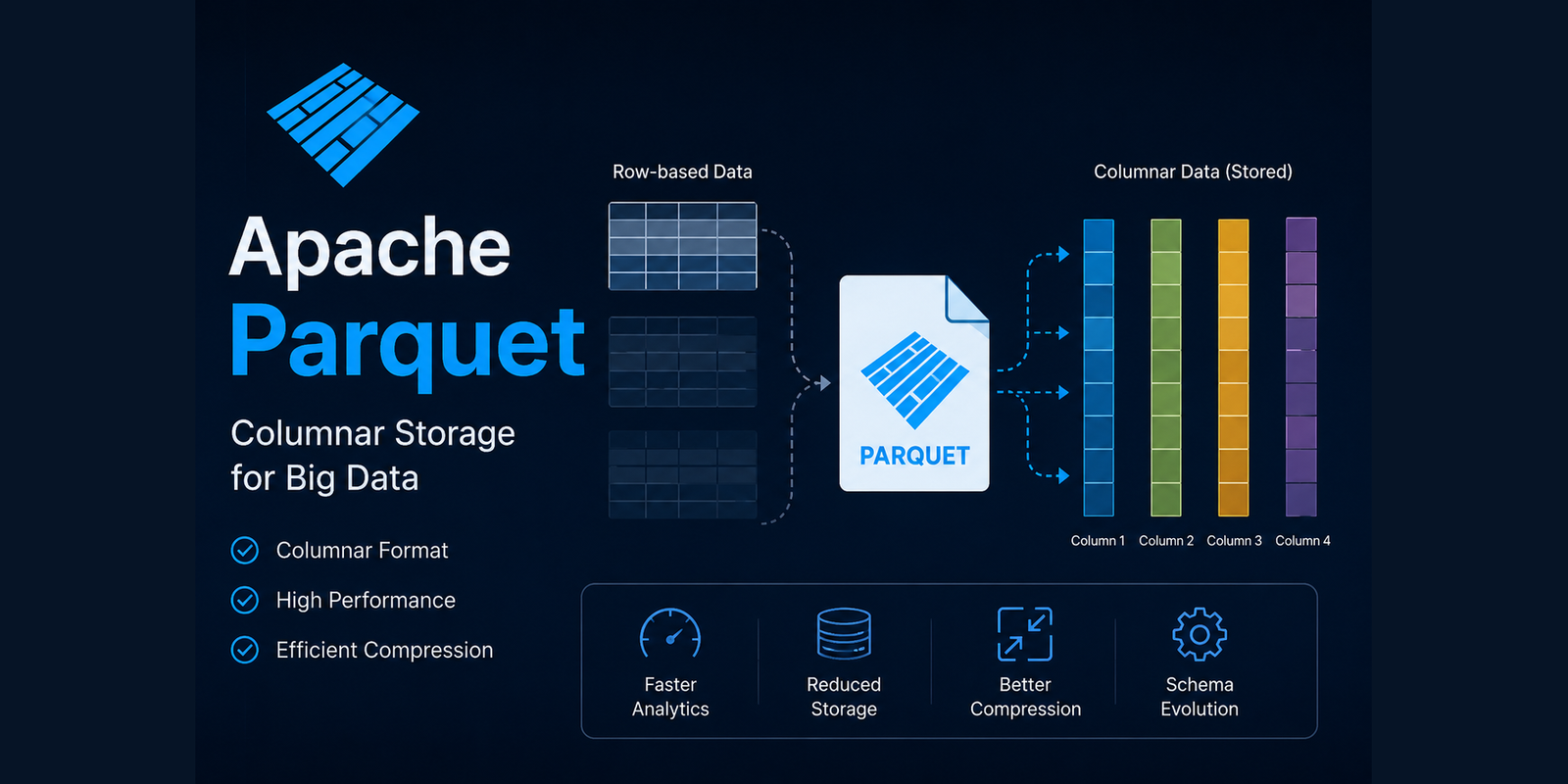
Apache Parquet is often described as a fast storage format, but the speed does not come from a single optimization. Instead, it combines several intelligent techniques that work together to minimize disk reads, reduce CPU overhead, and improve query execution.
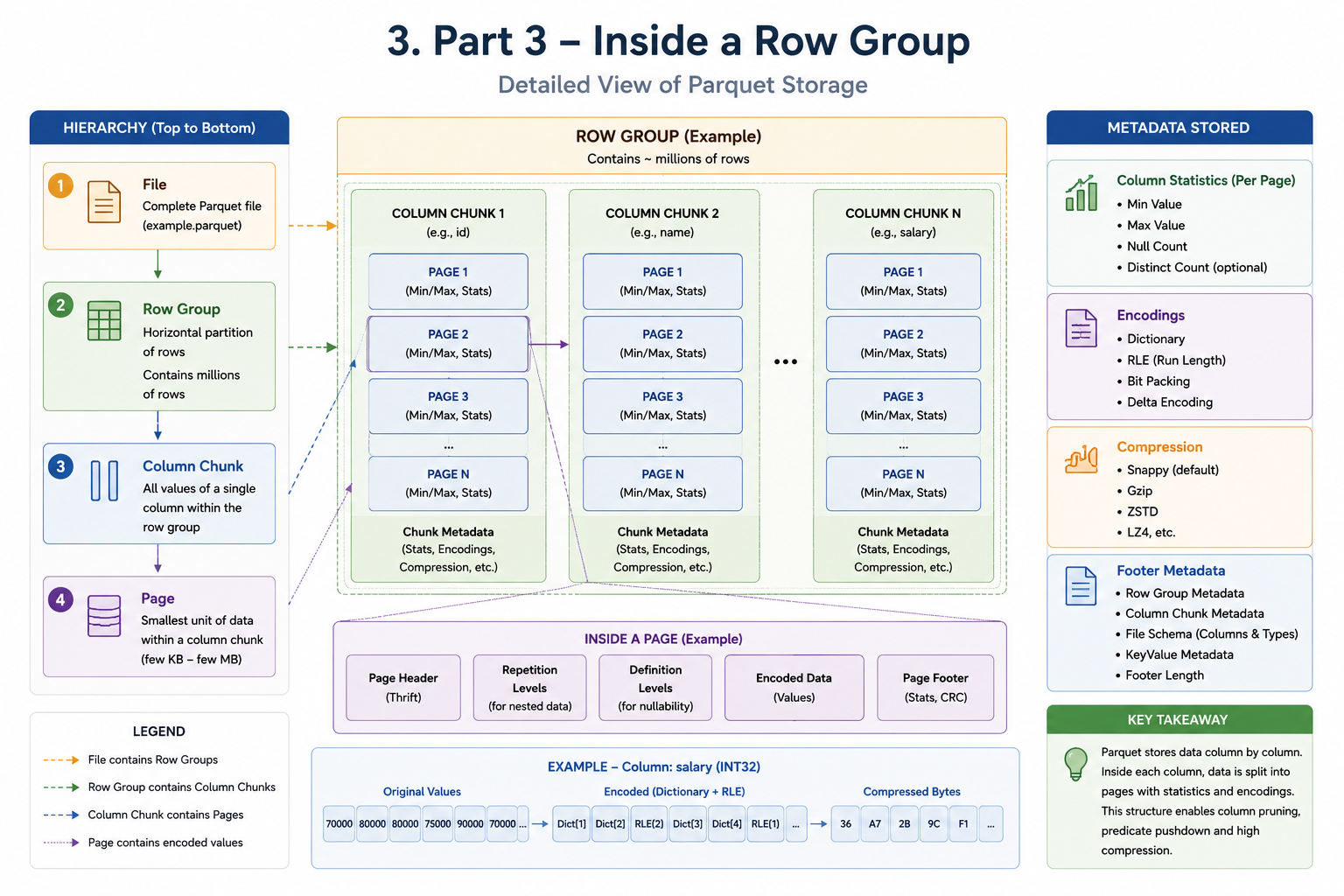
Why Apache Parquet delivers exceptional query performance
Some of the major performance optimizations include predicate pushdown, column pruning, data compression, efficient encoding, parallel processing, and metadata-based file skipping.
- Predicate Pushdown
- Column Pruning
- Data Compression
- Efficient Encoding
- Parallel Processing
- Metadata-Based File Skipping
Let us explore each of these concepts in detail.
Predicate pushdown: filtering data before reading it
One of Parquet biggest strengths is Predicate Pushdown. Instead of reading every row and applying filters afterward, Parquet attempts to determine which parts of the file can be skipped before any data is loaded into memory.
Consider the following SQL query:
SELECT *
FROM employees
WHERE salary > 120000;
Imagine a Parquet file divided into four Row Groups.
Row Group 1
Salary: 25,000 - 60,000

Row Group 2
Salary: 60,001 - 90,000

Row Group 3
Salary: 90,001 - 120,000

Row Group 4
Salary: 120,001 - 180,000
Each Row Group stores statistics such as minimum value, maximum value, null count, and number of rows.
- Minimum value
- Maximum value
- Null count
- Number of rows
When Spark reads the footer, it immediately notices that Row Group 1, Row Group 2, and Row Group 3 cannot satisfy the condition. Only Row Group 4 needs to be read.
Instead of scanning the entire dataset, nearly 75 percent of the file is skipped before any records are processed. This dramatically reduces disk I/O, network transfer, memory consumption, and query execution time.
For large datasets, Predicate Pushdown often provides one of the biggest performance improvements.
Column pruning: reading only what you need
Another optimization that makes Parquet highly efficient is Column Pruning. Suppose an employee table contains 40 columns.
EmployeeID
Name
Email
Phone
Department
Address
City
Country
Salary
JoiningDate
...
Now consider this query:
SELECT salary
FROM employees;
A row-based format such as CSV still has to read every column because the entire record is stored together. Parquet behaves differently. It reads only the Salary column and completely ignores the remaining 39 columns.
✓ Salary

✗ EmployeeID
✗ Name
✗ Email
✗ Phone
✗ Department
✗ Address
...
This significantly reduces the amount of data transferred from storage to memory. In analytical workloads where tables often contain dozens or even hundreds of columns, Column Pruning can reduce data reads by more than 90 percent.
Compression: why Parquet files are much smaller
Storage costs become significant when datasets reach terabytes or petabytes. Parquet addresses this problem by compressing data at the column level.
Unlike text-based formats, columns usually contain similar types of values. For example:
Department

Engineering
Engineering
Engineering
Engineering
Engineering
Engineering
Since many adjacent values are similar, compression algorithms can store them far more efficiently than plain text. Parquet supports multiple compression codecs, including:
Compression | Best Use Case
------------|-------------------------------------------------
Snappy      | Fast compression and decompression
Gzip        | Higher compression ratio
ZSTD        | Excellent balance between speed and compression
Brotli      | Maximum compression for storage-focused workloads
LZ4         | Extremely fast decompression
Among these, Snappy is the most commonly used because it provides an excellent balance between storage savings and processing speed. Many production environments choose Snappy as the default compression codec for Spark workloads.
Efficient encoding techniques
Compression is not the only reason Parquet files remain compact. Before compression is even applied, Parquet performs encoding, which transforms the data into a representation that requires fewer bytes.
Dictionary encoding
Suppose a column contains country names.
India
India
India
USA
USA
Canada
India
USA
Instead of storing the complete text repeatedly, Parquet builds a dictionary.
1 → India

2 → USA

3 → Canada
The actual column then becomes:
1
1
1
2
2
3
1
2
Since integers occupy much less space than strings, storage size decreases considerably. Dictionary Encoding is especially effective for columns containing repeated values.
Run-length encoding
Consider the following sequence.
A
A
A
A
A
A
A
A
Instead of storing eight identical values individually, RLE stores:
A × 8This dramatically reduces storage requirements whenever identical values appear consecutively.
Bit packing
Sometimes a column contains only a few possible values. For example:
0
1
0
1
1
0
Using an entire byte for every value would waste storage. Bit Packing stores multiple values inside a single byte, improving storage efficiency even further.
Delta encoding
Delta Encoding works well for increasing numeric values. For example:
1000
1002
1005
1006
1009
Instead of storing every number, Parquet stores the differences.
1000
+2
+3
+1
+3
Since the differences are much smaller than the original values, they compress far more effectively.
Combining compression and encoding
One common misconception is that compression alone makes Parquet efficient. In reality, the optimization pipeline looks like this:
Raw Data

↓

Encoding

↓

Compression

↓

Disk Storage
Encoding first transforms the data into a compact representation. Compression algorithms then work on this already optimized data, producing much smaller files than either technique could achieve independently.
This layered optimization is one of the main reasons Parquet files are often 5 to 15 times smaller than equivalent CSV datasets while also delivering significantly faster query performance.
What is next?
We have now explored the techniques that make Parquet incredibly fast, but another equally important feature is its ability to evolve alongside changing datasets.
- Schema Evolution
- Nested Data Structures
- Partitioning Strategies
- Best Practices for Data Lakes
- Common Mistakes That Hurt Performance
These topics are especially important for engineers building production-grade data pipelines with Apache Spark, Iceberg, Delta Lake, and cloud-based lakehouse architectures.