
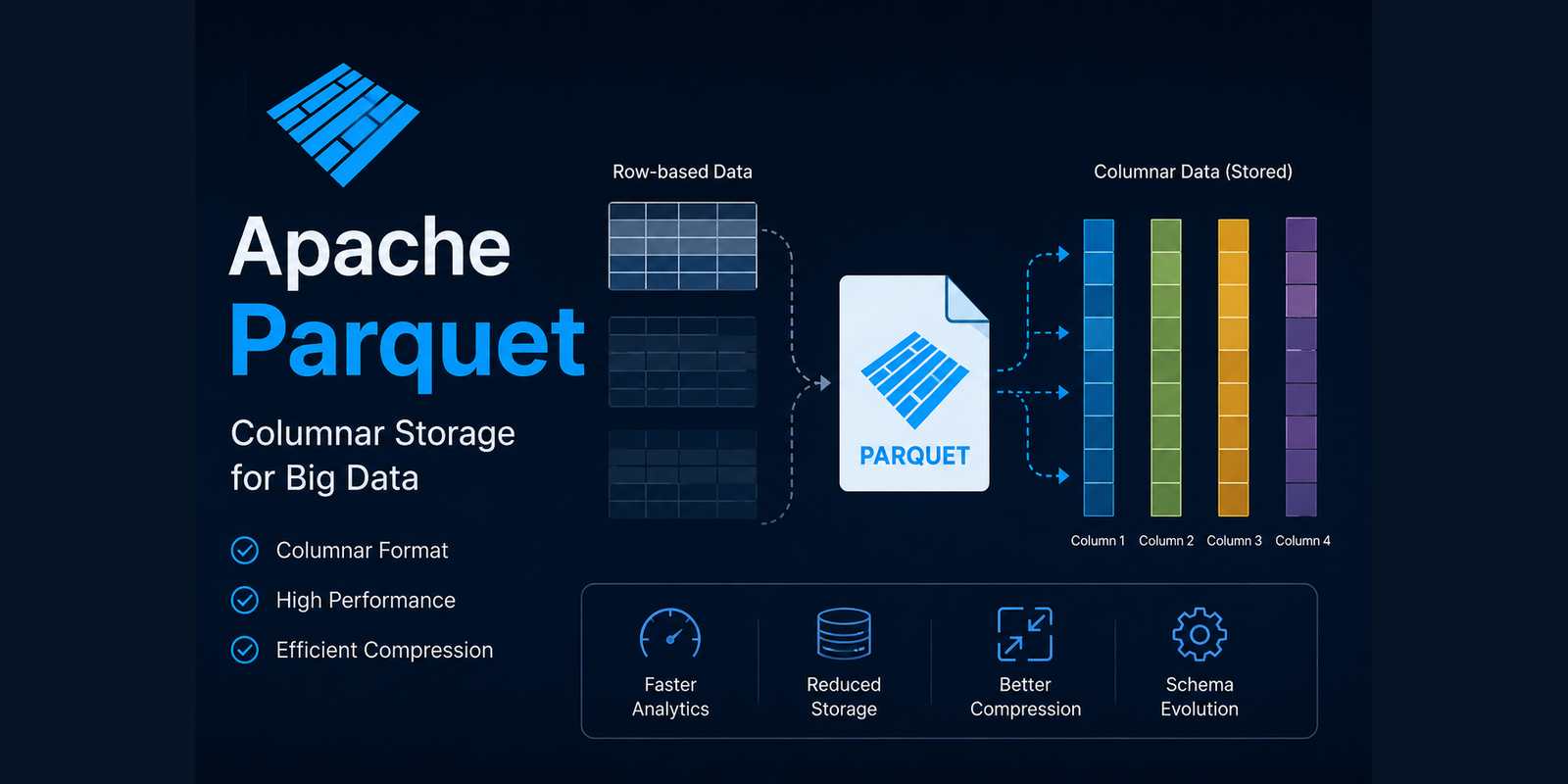
Apache Parquet is one of the most widely adopted storage formats in modern data engineering. However, as technologies such as Apache Iceberg, Delta Lake, and Apache Hudi have gained popularity, many engineers assume they are alternatives to Parquet.
In reality, these technologies solve different problems. Parquet defines how data is physically stored, while Iceberg, Delta Lake, and Hudi define how datasets are managed.
Understanding this distinction is essential when designing modern data lake and lakehouse architectures.
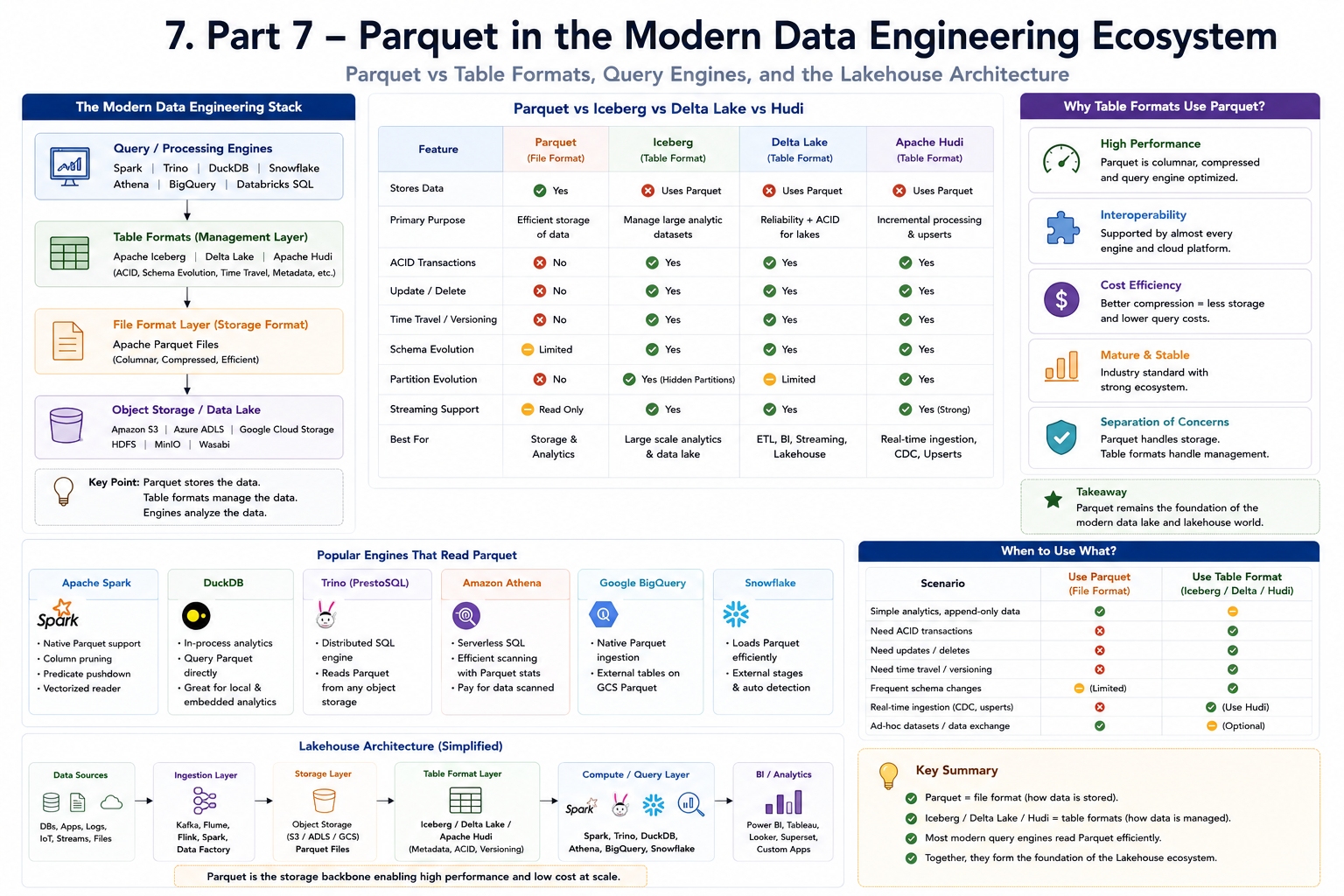
File Format vs Table Format
One of the most common misconceptions is treating Parquet and Iceberg as competing technologies. They are not competitors. Think of them as two different layers in the data stack.
+---------------------------------------+
|      SQL Engine / Processing Layer    |
| Spark | Trino | DuckDB | Snowflake    |
+---------------------------------------+
|          Table Format Layer           |
| Iceberg | Delta Lake | Apache Hudi    |
+---------------------------------------+
|           File Format Layer           |
|        Apache Parquet Files           |
+---------------------------------------+
|           Object Storage              |
| Amazon S3 | Azure ADLS | Google GCS   |
+---------------------------------------+
At the lowest level, Parquet stores the actual data. Above it, table formats maintain metadata, snapshots, schemas, transaction logs, and version history. Finally, processing engines such as Spark or Trino read those datasets and execute analytical queries.
In other words:
- Parquet stores data.
- Iceberg, Delta Lake, and Hudi manage that data.
- Spark, DuckDB, Snowflake, and Trino analyze that data.
Why Table Formats Were Introduced
Traditional Parquet files work extremely well for analytical workloads. However, they have several limitations.
- No ACID transactions
- No built-in version history
- Limited support for updates and deletes
- No rollback capability
- Difficult metadata management at large scale
Imagine an e-commerce company storing billions of customer orders. If a batch job fails halfway through writing Parquet files, the dataset may become inconsistent because Parquet itself has no transaction mechanism.
Table formats solve this problem. Instead of changing how data is stored, they add a management layer on top of Parquet files.
Apache Iceberg
Apache Iceberg is a table format designed for massive analytical datasets. Instead of relying on directory structures for partition discovery, Iceberg maintains its own metadata tables.
This provides several advantages:
- ACID transactions
- Hidden partitioning
- Snapshot isolation
- Time travel
- Schema evolution
- Partition evolution
- Faster metadata operations
Unlike traditional Hive-style partitioning, Iceberg tracks partitions internally, allowing developers to modify partition strategies without rewriting existing queries.
For organizations managing petabytes of data, this significantly simplifies long-term maintenance.
Delta Lake
Delta Lake is another popular table format built around Parquet files. Its distinguishing feature is the transaction log, often referred to as the Delta Log.
Every modification to the dataset is recorded in this log. This enables capabilities such as:
- Atomic transactions
- Schema enforcement
- Time travel
- Update operations
- Delete operations
- Merge (UPSERT)
- Streaming and batch integration
These features make Delta Lake particularly attractive for pipelines that require frequent data modifications rather than append-only workloads.
Apache Hudi
Apache Hudi focuses on incremental data processing and near real-time ingestion. While Parquet files remain the underlying storage format, Hudi adds metadata and indexing layers that make updates significantly more efficient.
Some of its core capabilities include:
- Record-level updates
- Incremental queries
- Efficient deletes
- Change Data Capture (CDC)
- Streaming ingestion
- Automatic compaction
Hudi is commonly used when datasets receive continuous updates throughout the day.
Comparing the Technologies
The following table highlights the role of each technology.
| Technology     | Primary Role | Stores Data?   | Supports ACID? |
| -------------- | ------------ | -------------- | -------------- |
| Apache Parquet | File Format  | Yes            | No             |
| Apache Iceberg | Table Format | Uses Parquet   | Yes            |
| Delta Lake     | Table Format | Uses Parquet   | Yes            |
| Apache Hudi    | Table Format | Uses Parquet   | Yes            |
This comparison makes one point clear: Parquet is not replaced by these technologies. Instead, it continues to serve as the underlying storage layer for many modern lakehouse implementations.
How Modern Query Engines Use Parquet
One reason Parquet has become the industry standard is its broad compatibility. Almost every modern analytics engine can read Parquet files efficiently.
Apache Spark
Spark uses Parquet as its default storage format for many analytical workloads. It leverages features such as column pruning, predicate pushdown, vectorized readers, and distributed execution to process large datasets efficiently.
DuckDB
DuckDB can query Parquet files directly without requiring a separate database server. This allows analysts to perform interactive SQL queries against local or cloud-hosted Parquet datasets with minimal setup.
Trino
Trino is designed for distributed SQL queries across multiple data sources. Because it understands Parquet metadata, it can avoid scanning unnecessary columns and Row Groups, improving performance for large analytical workloads.
Amazon Athena
Athena queries Parquet files stored in Amazon S3 using serverless SQL. Since users pay based on the amount of data scanned, Parquet columnar storage can significantly reduce query costs by limiting the amount of data read.
Google BigQuery
BigQuery supports loading Parquet files directly and can also query external Parquet datasets stored in Google Cloud Storage. This makes Parquet an excellent interchange format for cloud-native analytics pipelines.
Snowflake
Snowflake integrates seamlessly with Parquet for bulk data loading and external table access. Many organizations use Parquet as an exchange format between Spark jobs, cloud object storage, and Snowflake data warehouses.
Where Parquet Fits in a Lakehouse Architecture
A modern lakehouse often follows an architecture similar to the one below.
                Business Users

                      │

              BI Dashboards

                      │

        Power BI | Tableau | Looker

                      │

        Spark | Trino | Snowflake

                      │

 Iceberg / Delta Lake / Apache Hudi

                      │

          Apache Parquet Files

                      │

 Amazon S3 | Azure ADLS | Google GCS
Notice that Parquet remains the physical storage layer regardless of which table format or processing engine is used.
This layered architecture allows organizations to separate data storage from metadata management and query execution, making the platform more scalable and easier to evolve.
Choosing the Right Technology
Each technology serves a different purpose.
Choose Apache Parquet when:
- Building analytical datasets.
- Optimizing storage and query performance.
- Working with append-only batch pipelines.
- Sharing datasets across multiple processing engines.
Choose a table format such as Iceberg, Delta Lake, or Hudi when:
- Multiple jobs modify the same dataset.
- ACID transactions are required.
- Data needs to be updated or deleted.
- Time travel or version history is important.
- Schema changes occur frequently.
In practice, most production lakehouse platforms combine both approaches, using Parquet for storage and a table format for data management.
What is next?
At this point, we have covered how Parquet stores data, why it performs so well, how Spark processes it, and how it integrates into modern lakehouse architectures.
In the final section, we will bring everything together by exploring common mistakes, when Parquet is not the right choice, format comparisons, interview questions, a quick-reference cheat sheet, and key production recommendations.