
In today's data-driven world, organizations generate massive amounts of information every second. From application logs and IoT sensors to financial transactions and customer interactions, modern data pipelines process millions of records daily. While collecting this data is relatively straightforward, storing it efficiently and querying it at scale presents a much bigger challenge.
For years, formats such as CSV and JSON were the default choice for exchanging and storing data. Although they are simple, human-readable, and widely supported, they begin to show serious limitations as datasets grow from megabytes to terabytes. Reading large text files requires scanning every record, consumes more storage, and often results in slower analytical queries.
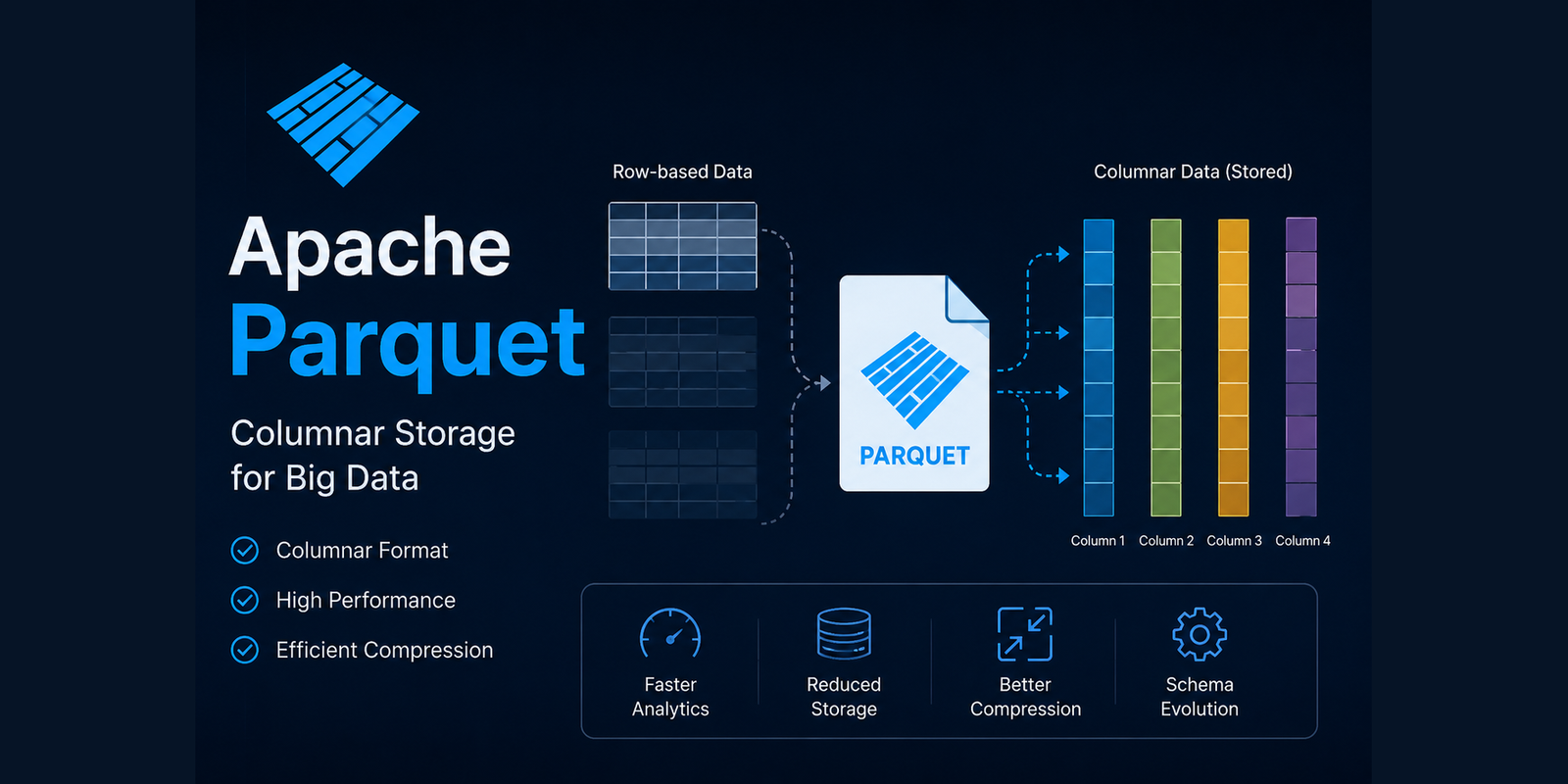
To overcome these limitations, the data engineering community adopted Apache Parquet, a columnar storage format specifically designed for analytical workloads. Instead of storing data row by row, Parquet organizes values by columns, allowing query engines to read only the information they actually need. This design dramatically reduces disk I/O, improves compression, and accelerates large-scale analytics.
Today, Apache Parquet has become the de facto storage format across modern data platforms. It is widely used by technologies such as Apache Spark, DuckDB, Apache Hive, Trino, Presto, Snowflake, BigQuery, Amazon Athena, and Databricks because of its efficiency, interoperability, and performance.
In this guide, we will take a deep dive into Apache Parquet, from its internal architecture and storage model to advanced concepts like predicate pushdown, compression, encoding techniques, and schema evolution. We will also discuss practical optimization strategies, production best practices, and situations where Parquet may not be the right choice.
By the end of this article, you will understand not only how Parquet works, but also why it has become one of the most important file formats in modern data engineering.
What is Apache Parquet?
Apache Parquet is an open-source, column-oriented file format created for efficient storage and fast analytical processing of large datasets. It was originally developed through collaboration between Twitter and Cloudera and later became an Apache Software Foundation project.
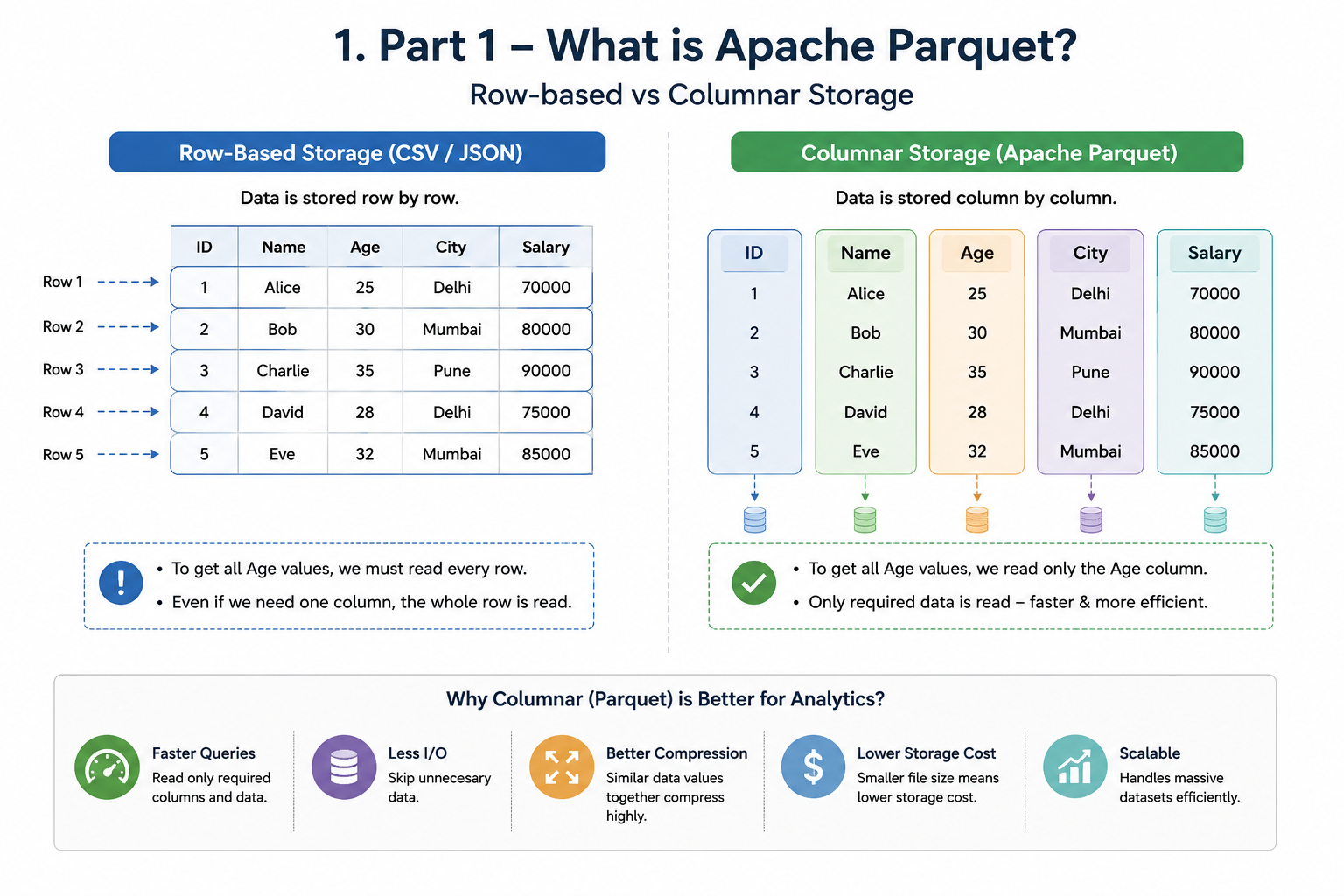
Unlike traditional file formats that store complete records sequentially, Parquet groups data by individual columns. This seemingly simple design decision has a huge impact on storage efficiency and query performance.
Row-based storage versus columnar storage
Consider the following dataset:
Employee ID | Name    | Department  | Salary
------------|---------|-------------|--------
101         | Alice   | Engineering | 90000
102         | Bob     | Finance     | 75000
103         | Charlie | HR          | 68000
If this data is stored in a row-based format such as CSV, values are written row after row.
101 | Alice   | Engineering | 90000
102 | Bob     | Finance     | 75000
103 | Charlie | HR          | 68000
A columnar format stores the same values differently. Each column is grouped together, which allows the query engine to access only the required fields.
Employee ID
------------
101
102
103

Name
-----
Alice
Bob
Charlie

Department
-----------
Engineering
Finance
HR

Salary
------
90000
75000
68000
This layout may appear unusual at first, but it provides several important advantages for analytical workloads. Suppose a data analyst wants to calculate the average salary of one million employees.
SELECT AVG(salary)
FROM employees;
With a CSV file, the database engine must read every column of every row, even though only the Salary column is required. With Parquet, only the Salary column is loaded into memory, while the remaining columns are skipped entirely.
- Much less data is read from disk.
- Query execution becomes significantly faster.
- Memory consumption decreases.
- CPU resources are used more efficiently.
This concept, known as column pruning, is one of the primary reasons Parquet delivers excellent performance for analytical queries.
Why traditional file formats become a bottleneck
Before understanding Parquet architecture, it is helpful to examine why traditional formats struggle with large-scale analytics. CSV and JSON are useful formats, but they were not designed for efficient analytical scans across massive datasets.
CSV limitations
CSV files are extremely popular because they are lightweight, portable, and easy to inspect manually. However, they were never designed for analytical processing.
- Every value is stored as plain text.
- Data types are not preserved.
- Compression is limited.
- Queries usually require scanning the entire file.
- Metadata is not stored with the dataset.
As datasets grow into hundreds of gigabytes or even terabytes, these limitations become increasingly expensive.
JSON limitations
JSON improves flexibility by supporting nested structures and complex objects, making it an excellent choice for APIs and data exchange. However, analytical engines face several challenges when processing JSON files.
- Repeated field names increase file size.
- Parsing nested documents requires additional CPU resources.
- Compression ratios are generally lower than columnar formats.
- Reading only a subset of fields is inefficient because much of the document still needs to be parsed.
For transactional systems, these drawbacks are often acceptable. For analytical workloads involving billions of records, they become a significant performance bottleneck.
Why columnar storage wins
Analytical queries rarely require every column from a dataset. Reading employee names, departments, email addresses, phone numbers, and locations would simply waste disk bandwidth and memory when only a single metric is needed.
Parquet avoids this unnecessary work by reading only the required columns. This optimization is one of the key reasons why Parquet has become the preferred storage format for modern data warehouses and lakehouse architectures.
What is next?
Now that we have understood why Parquet exists, the next step is to explore how it actually stores data internally. The internal architecture includes file structure, row groups, column chunks, data pages, footer metadata, magic bytes, and the way query engines read a Parquet file.
Understanding these internal components is essential because every major optimization in Parquet, including compression, predicate pushdown, parallel processing, and column pruning, builds upon this architecture.