
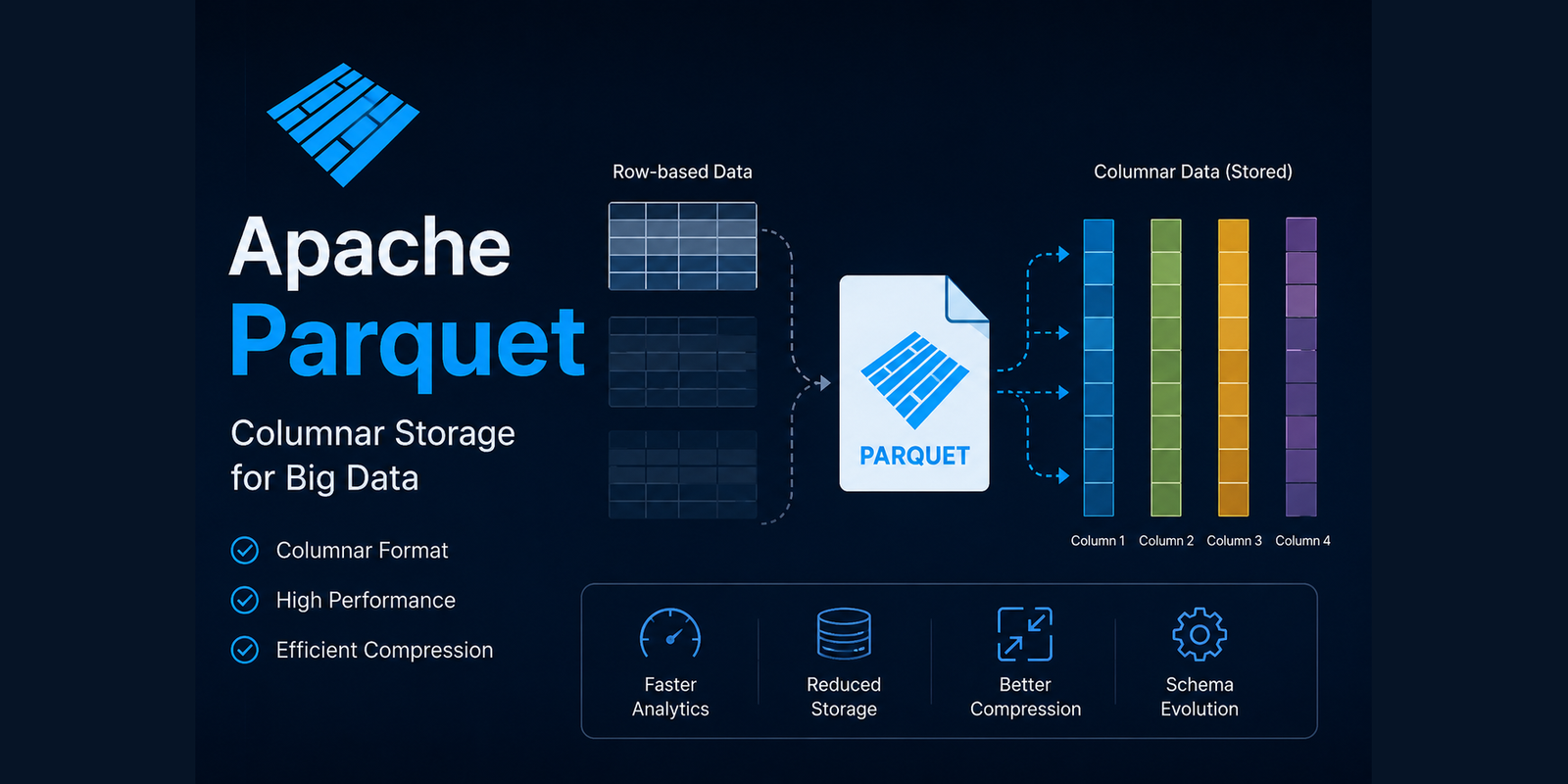
Although Apache Parquet is highly optimized for analytical workloads, its performance depends heavily on how datasets are designed and managed. Many performance issues arise not because of the file format itself, but because of poor implementation choices.
Below are some of the most common mistakes seen in production environments and the practices that help avoid them.
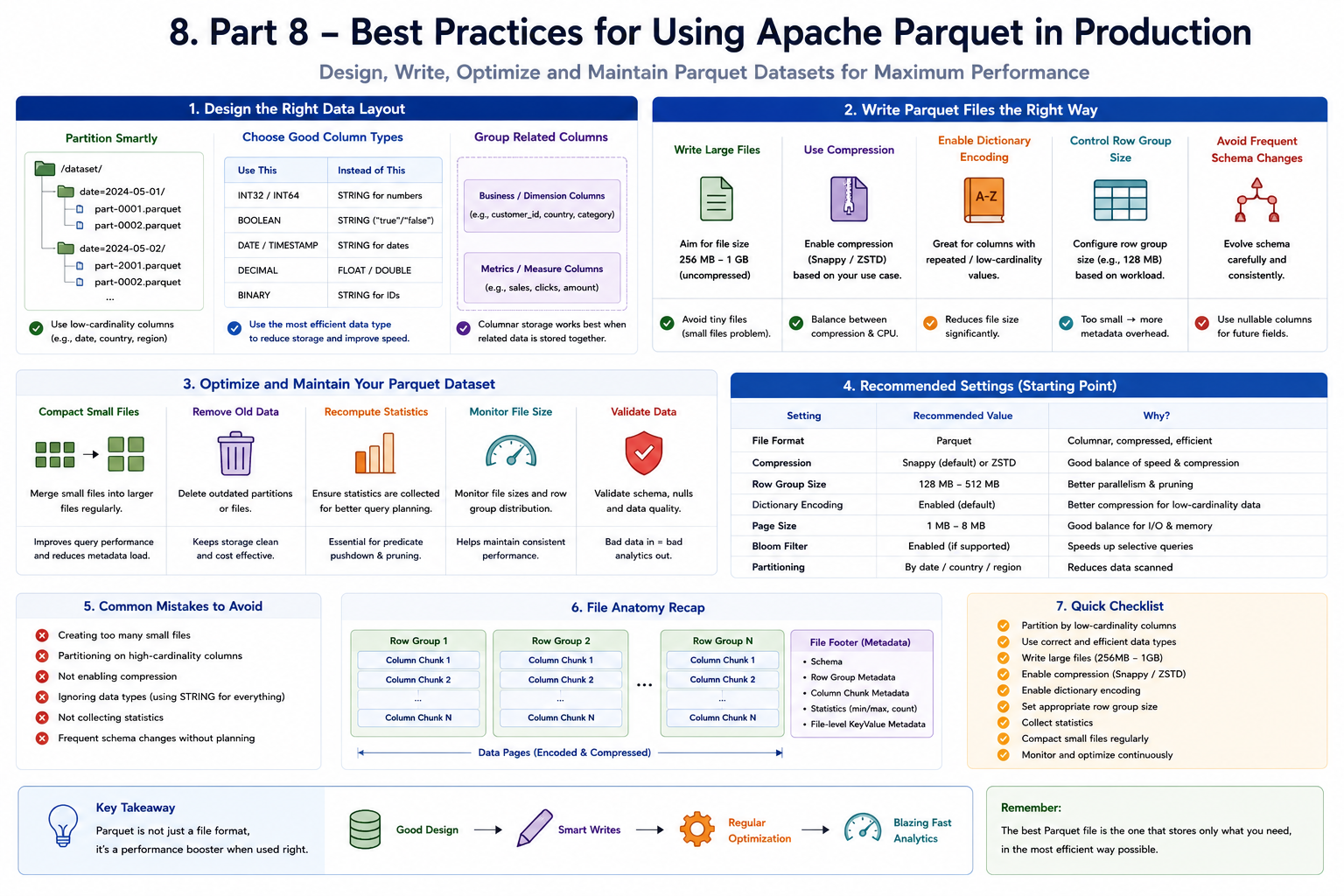
Writing Too Many Small Files
Generating thousands of tiny Parquet files increases metadata overhead and forces processing engines to spend more time discovering and opening files than actually reading data.
Instead, periodically compact small files into larger ones that are better suited for analytical processing.
Choosing Poor Partition Columns
Partitioning by high-cardinality columns such as user_id, transaction_id, or email creates an excessive number of partitions.
This leads to:
- Increased metadata
- Slower query planning
- Higher storage API calls
- Reduced performance
Partition using columns that naturally limit the search space, such as dates, regions, or business units.
Ignoring Compression
Leaving Parquet files uncompressed wastes storage and increases the amount of data transferred during queries.
Select an appropriate compression codec based on your workload and benchmark the results before standardizing on one.
Frequently Changing Schemas
Adding or modifying columns without a proper schema management strategy can complicate downstream processing.
When schema evolution is expected, consider using a table format that provides stronger schema management capabilities.
Skipping Performance Validation
A common assumption is that simply converting CSV files to Parquet guarantees better performance.
In reality, query speed depends on multiple factors, including partitioning strategy, file size, compression, and query patterns.
Always validate improvements using representative workloads rather than assumptions.
Situations Where Parquet May Not Be the Best Choice
Although Parquet is an excellent storage format for analytics, it is not the ideal solution for every workload.
Consider other options when:
- Data is updated continuously at the individual record level.
- Low-latency transactional access is required.
- Files are extremely small and short-lived.
- Human-readable text files are preferred for debugging or manual editing.
- Real-time operational systems require frequent inserts, updates, or deletes.
In these scenarios, row-oriented databases or transactional table formats may provide a better fit.
Comparing Popular Data Storage Formats
Choosing the right storage format depends on your workload rather than popularity. The following comparison highlights the strengths of commonly used formats.
| Feature            | CSV           | JSON     | Avro      | ORC             | Parquet                |
| ------------------ | ------------- | -------- | --------- | --------------- | ---------------------- |
| Storage Layout     | Row           | Row      | Row       | Column          | Column                 |
| Human Readable     | Yes           | Yes      | No        | No              | No                     |
| Compression        | Limited       | Moderate | Good      | Excellent       | Excellent              |
| Schema Support     | No            | Limited  | Yes       | Yes             | Yes                    |
| Nested Data        | No            | Yes      | Yes       | Yes             | Yes                    |
| Analytical Queries | Poor          | Moderate | Good      | Excellent       | Excellent              |
| Best For           | Data Exchange | APIs     | Streaming | Data Warehouses | Data Lakes & Analytics |
In general:
- CSV works well for simple data exchange.
- JSON is ideal for APIs and semi-structured documents.
- Avro is commonly used for serialization and streaming platforms such as Kafka.
- ORC is optimized for large-scale warehouse workloads, particularly in the Hadoop ecosystem.
- Parquet is the preferred choice for modern analytical processing and lakehouse architectures.
Interview Questions You Should Be Able to Answer
If you are preparing for a Data Engineering interview, these are some of the most frequently discussed topics related to Apache Parquet.
- What is Apache Parquet?
- Why is Parquet faster than CSV?
- What is columnar storage?
- What are Row Groups?
- What are Column Chunks?
- What are Data Pages?
- What information is stored in the Parquet footer?
- How does Predicate Pushdown work?
- What is Column Pruning?
- What is Dictionary Encoding?
- How does Run-Length Encoding improve compression?
- What is Delta Encoding?
- Why does Parquet achieve better compression ratios?
- What is Schema Evolution?
- What is the Small Files Problem?
- How should Parquet datasets be partitioned?
- What is the difference between Parquet and ORC?
- What is the difference between a File Format and a Table Format?
- Why do Iceberg and Delta Lake still use Parquet?
- Which Spark optimizations improve Parquet performance?
Being comfortable with these topics provides a strong foundation for both interviews and production-level work.
Apache Parquet Cheat Sheet
| Topic                     | Key Takeaway                                                   |
| ------------------------- | -------------------------------------------------------------- |
| Storage Model             | Column-oriented                                                |
| Best Workload             | Analytical processing (OLAP)                                   |
| Poor Fit                  | High-frequency transactional updates (OLTP)                    |
| Compression               | Snappy, Gzip, ZSTD, LZ4, Brotli                                |
| Core Optimizations        | Predicate Pushdown, Column Pruning, Encoding                   |
| Internal Components       | Row Groups, Column Chunks, Pages, Footer Metadata              |
| Typical Storage           | Amazon S3, Azure Data Lake Storage, Google Cloud Storage, HDFS |
| Common Processing Engines | Spark, Trino, DuckDB, Snowflake, BigQuery, Athena              |
| Table Formats             | Iceberg, Delta Lake, Apache Hudi                               |
| Recommended Use Case      | Large-scale analytical datasets                                |
Keep this table as a quick reference whenever you are designing or reviewing a data pipeline.