
Generative AI is transforming the way businesses build software, automate workflows, and deliver personalized customer experiences. Organizations across industries are moving beyond AI experiments and deploying production-ready AI applications powered by Large Language Models.
However, managing AI infrastructure, selecting the right model, handling security, and scaling applications can quickly become complex. This is where Amazon Bedrock comes in.
Amazon Bedrock is AWS's fully managed generative AI platform that allows developers to build, customize, and deploy AI applications without managing GPUs or machine learning infrastructure.
In this guide, you will learn what Amazon Bedrock is, its core features, benefits, architecture, and how to start building enterprise-grade generative AI applications on AWS.
What is Amazon Bedrock?
Amazon Bedrock is a fully managed generative AI service from AWS that provides access to multiple foundation models through a single API.
Instead of provisioning GPU instances, configuring machine learning infrastructure, or hosting models yourself, Bedrock lets you focus entirely on building AI-powered applications.
- Build AI chatbots.
- Create intelligent assistants.
- Generate text, code, and images.
- Build Retrieval-Augmented Generation applications.
- Develop AI agents.
- Fine-tune foundation models.
- Secure AI applications with built-in guardrails.
One of the biggest advantages of Amazon Bedrock is that it supports models from multiple AI providers through a unified interface. Although Bedrock is widely known for Large Language Models, it also supports image generation and other multimodal AI capabilities.
Why Amazon Bedrock Matters
Building production-ready AI applications requires much more than simply calling an LLM. Organizations need secure infrastructure, model flexibility, enterprise governance, cost optimization, scalability, and low operational overhead.
Amazon Bedrock combines these capabilities into a single managed service, allowing engineering teams to build and deploy generative AI applications significantly faster.
Key Features of Amazon Bedrock
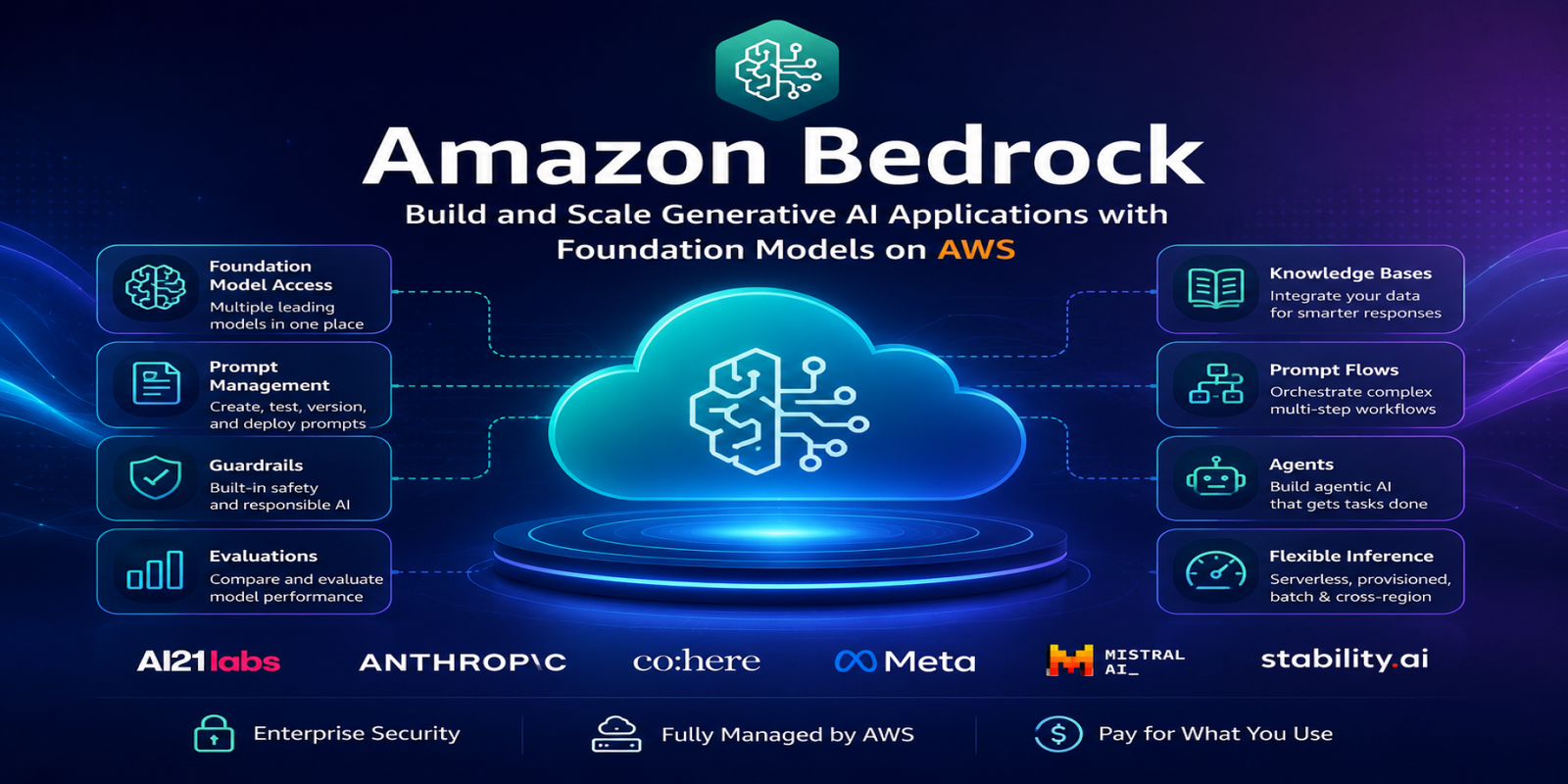
Amazon Bedrock brings together model access, customization, prompt lifecycle management, knowledge bases, workflow orchestration, agents, guardrails, flexible inference, model evaluation, and visual development tools.
- Foundation model catalog with access to leading models for text generation, coding, summarization, image generation, and multimodal use cases.
- Custom model fine-tuning and continued pre-training using domain-specific datasets.
- Bedrock Playgrounds for no-code testing of chat completion, text generation, image generation, prompt engineering, and model comparison.
- Prompt Management for storing templates, versioning prompts, testing variations, evaluating responses, and deploying production prompts.
- Knowledge Bases for building Retrieval-Augmented Generation applications connected to enterprise data sources.
- Prompt Flows for orchestrating multi-step AI workflows with shared context between steps.
- AI Agents that can plan tasks, make decisions, invoke APIs, access enterprise data, and complete multi-step operations.
- Guardrails for blocking harmful content, defending against prompt injection, filtering unsafe responses, and protecting enterprise applications.
- Flexible inference options including on-demand serverless inference, provisioned throughput, batch inference, and cross-region inference.
- Model Evaluation tools for comparing models by accuracy, latency, cost, response quality, and task performance.
- Bedrock Studio for visually building and experimenting with AI applications.
Benefits of Using Amazon Bedrock
Amazon Bedrock removes much of the infrastructure burden from generative AI development. There is no need to provision GPUs, configure Kubernetes clusters, or manage model deployments because AWS handles the underlying infrastructure.
- Serverless AI infrastructure so teams can focus on product development.
- Access to multiple AI models through one unified API.
- Enterprise security through IAM integration, encryption, guardrails, monitoring, logging, and compliance controls.
- Faster time-to-market because infrastructure management is eliminated.
- Cost optimization through pay-as-you-go usage, provisioned throughput, serverless inference, and usage monitoring.
Common Use Cases for Amazon Bedrock
Amazon Bedrock can support many enterprise and product use cases where teams need secure and scalable access to foundation models.
- AI chatbots.
- Customer support assistants.
- Internal knowledge assistants.
- Enterprise search.
- Code generation tools.
- Document summarization.
- Content generation platforms.
- Marketing automation.
- AI agents.
- Image generation applications.
- Retrieval-Augmented Generation systems.
How to Get Started with Amazon Bedrock
There are several ways to begin developing with Amazon Bedrock depending on whether you want a visual console experience, direct API integration, SDK-based development, or a unified AI development environment.
- Use the AWS Management Console to explore models, Playgrounds, Prompt Management, and Knowledge Bases without writing code.
- Invoke foundation models directly through the Amazon Bedrock API.
- Use AWS SDKs for Java, Python, JavaScript, .NET, and Go to integrate Bedrock into backend services.
- Use Amazon SageMaker Unified Studio to build and manage AI solutions from a unified environment.
Is Amazon Bedrock Worth Learning?
Absolutely. As generative AI adoption continues to grow, organizations are looking for managed platforms that simplify AI development while meeting enterprise requirements for security, scalability, and governance.
Amazon Bedrock removes much of the operational complexity involved in deploying Large Language Models, making it an excellent choice for developers, startups, and enterprises building production-ready AI applications on AWS.
If you are planning a career in cloud computing, machine learning, or generative AI, learning Amazon Bedrock is becoming an increasingly valuable skill.
Conclusion
Amazon Bedrock is much more than an API for Large Language Models. It is a complete generative AI platform that combines model diversity, serverless infrastructure, enterprise security, prompt management, knowledge bases, AI agents, and workflow orchestration into a single managed service.
Whether you are building a chatbot, a Retrieval-Augmented Generation system, an AI-powered search engine, or autonomous AI agents, Amazon Bedrock provides the tools needed to build scalable, secure, and production-ready generative AI applications.
This article covered the fundamentals of Amazon Bedrock. In upcoming articles, we will dive deeper into individual features such as Knowledge Bases, Prompt Flows, Guardrails, Agents, Model Customization, and real-world implementation examples.